

What Is a Chile Relleno? Puebla’s Stuffed Poblano, Explained
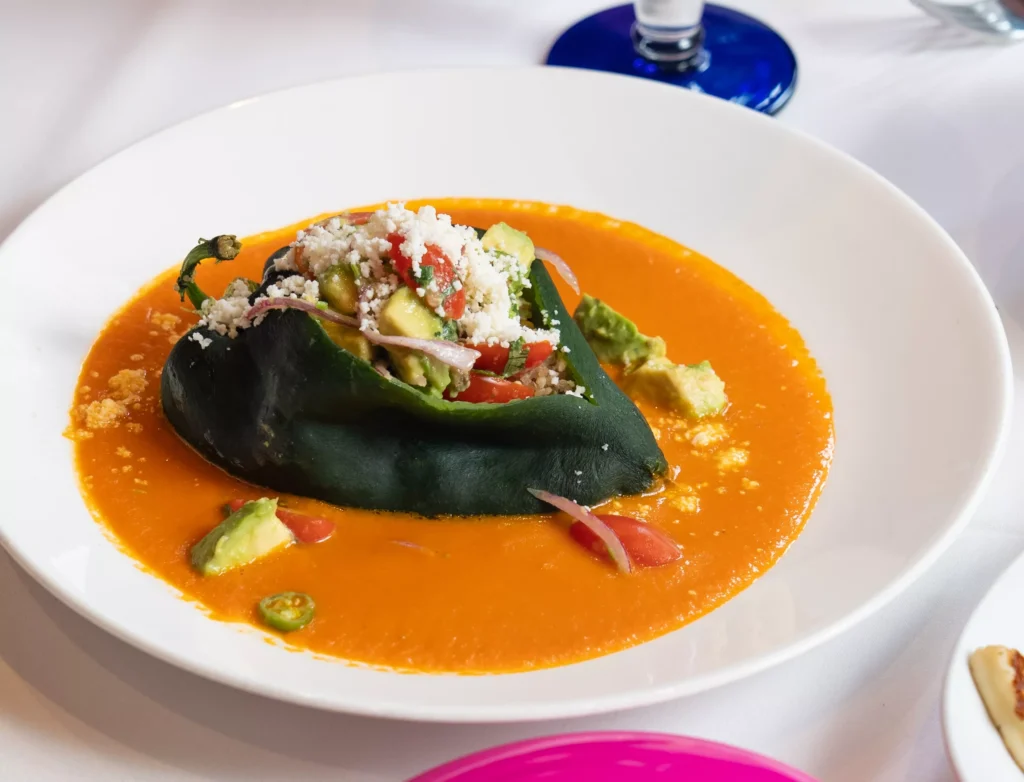
A chile relleno is a roasted poblano chile, stuffed and then cooked until the filling sets. That is the whole idea. What changes from one region and one kitchen to the next is what goes inside, and that variation is why the dish has lasted four centuries without ever settling into a single recipe.
What is a chile relleno?
The name translates literally: chile relleno, stuffed chile. In practice it describes a method rather than a fixed dish.
A poblano is roasted until the skin blisters, then peeled, slit open, and seeded while keeping its shape. It is filled — classically with cheese, sometimes with meat, increasingly with grains and vegetables — and finished in a sauce. The version most Americans picture, jacketed in whipped egg batter and fried, is one regional treatment among several. Plenty of kitchens skip the batter entirely and let the roasted chile stand on its own.
What unites all of them is the roasting step. A raw, stuffed, and baked chile is a different dish. Roasting and peeling first give a chile relleno its silky texture and the faint smoke that carries the whole plate.
Where does the chile relleno come from?
Puebla — the same city that gives Mexican cooking a surprising share of its most recognizable dishes.
The earliest written versions date to the seventeenth century, in Puebla convent kitchens where Spanish ingredients and techniques were folded into Indigenous ones. That same collision produced mole poblano, and the two dishes are siblings in a real sense: both are Pueblan, both are built on chiles, and both took their finished form in the same kitchens at roughly the same time.
It is also why the dish keeps coming up around Cinco de Mayo. The holiday marks the Battle of Puebla on 5 May 1862, and if you want to eat the occasion accurately rather than generically, Puebla’s own cooking is the place to look. Mole poblano is the headline answer. The chile relleno is the one you can actually order on an ordinary Tuesday.
What is a poblano, and why does it matter?
The poblano is a large, thick-walled, dark green chile named for Puebla, and its structure is why this dish exists at all.
Thin-walled chiles collapse when you roast and stuff them. The poblano has enough structure to hold a filling and enough surface to take on smoke, and it sits low on the heat scale — mild, earthy, closer to a sweet pepper than to anything that will hurt you. Dried and darkened, the same chile becomes the ancho, one of the backbone ingredients in mole. One chile, two of Puebla’s defining dishes.
What is in Rosa Mexicano’s chile relleno?
A quinoa pilaf‑stuffed poblano with Oaxaca cheese, crema, queso fresco and avocado, served in a roasted tomato chipotle sauce.
It is a vegetarian reading of the dish rather than a nostalgic one. The quinoa gives the filling enough body to stand up to the chile without the heaviness of a meat picadillo; the Oaxaca cheese does the pulling and melting that a classic relleno relies on; the chipotle in the sauce supplies the smoke that a batter‑fried version would get from the fryer. It sits on the main dining menu year-round rather than rotating seasonally, and you can see it on our menus.
How is a chile relleno different from chiles en nogada?
Same chile, different world. Both start with a roasted poblano, and that is where the resemblance stops.
Chiles en nogada fills the chile with picadillo — a spiced mixture of meat and fruit — then covers it in a cold walnut cream and scatters pomegranate seeds across the top. It is a celebration dish, tied to Mexican Independence Day in September, and it is genuinely seasonal: the fresh walnuts and pomegranates it depends on are available for only a few weeks a year, which is why it appears on menus in late summer and then vanishes.
The chile relleno has no such constraint. It is the everyday form of the same idea, which is exactly why it has spread so much further. If you came looking for chiles en nogada, the honest answer is that we do not serve it — and that the dish it descends from is on the menu every day of the year.
Experience the chile relleno at Rosa Mexicano
At Rosa Mexicano, we have cooked from Mexico’s regional traditions since we opened in New York City in 1984, and the chile relleno is one of the clearest examples of what that means in practice: an old Pueblan method, cooked properly, without pretending it is a museum piece. Start with our tableside guacamole en molcajete, pour an original frozen pomegranate margarita alongside it, and reserve a table to taste the rest.
Frequently asked questions
What does “poblano” mean?
It means “from Puebla.” The chile is named after the city and state where it has been grown and cooked longest. The same naming logic gives you mole poblano, which is why both dishes keep coming up in conversations about Puebla’s cooking.
Is a chile relleno spicy?
The poblano itself is mild by chile standards — closer to warm than hot, with more earthy sweetness than heat. Preparations vary, though, and ours is marked spicy on the menu because of the roasted tomato chipotle sauce it is served in rather than the chile.
Is Rosa Mexicano’s chile relleno vegetarian?
Yes. Ours is stuffed with a quinoa pilaf rather than meat, and it is marked vegetarian on the menu. It is not marked gluten-free, so if you are avoiding gluten, please tell your server, and they will walk you through the gluten-free dishes.
Is a chile relleno the same as a stuffed pepper?
Only in the loosest sense. A stuffed bell pepper is usually a raw pepper baked with a filling. A chile relleno starts with a chile that’s roasted and peeled first, which completely changes the texture and is where most of the flavor comes from.
Do you serve chiles en nogada?
No. Chiles en nogada is a stuffed poblano too, but it depends on walnuts and pomegranates that are only in season for a few weeks in late summer, which is why it appears on Mexican menus in August and September and then disappears. Our chile relleno is on the main dining menu year-round.